
Ready-to-Drink (RTD) cocktails are attracting brewery interest as a new growth opportunity with minimal operational change, as core beer growth has slowed. According to data from the Brewers Association, U.S. beer volume has remained flat or declined in recent years. Producers are under pressure to find new revenue streams to better manage costs and stabilize cash flow. RTDs, by contrast, have shown sustained momentum and pricing elasticity, making them an accessible portfolio extension.
Consumer demand for RTD continues to grow in the U.S., with RTD sales increasing +8.8% in value in early 2026 (4 weeks to Jan 2026), according to NielsenIQ. Distributors continue to increase focus on RTDs because they are increasingly favoring diversified portfolios that include spirits-adjacent products with higher dollar-per-case returns and consumer appeal. RTDs slip neatly into existing beer distribution channels, lowering barriers to entry and expanding opportunities.
As breweries explore new beverage categories, researchers studying brewing innovation note that the operational challenge is rarely the idea itself, but how to integrate new beverages into existing systems. “Brewers have always shown innovation,” states Dr. Glen Fox of University California-Davis,“ and in recent years, this has become more important to keep up with competing beverages. But how do brewers start to produce other beverages without expensive capital or redesigning brewery operations? Key factors will always be true to their beer brand and their history. Other factors they have to consider are the usual quality parameters (product sensory and stability), meeting regulatory requirements, keeping their loyal customers engaged but also bringing in new customers”
What “RTD Cocktail” Means in Practice
“RTD cocktail” is a market-facing term, not an operational one. In practice, RTDs fall into three materially different categories: spirit-based, malt-based, and wine-based. Each category carries distinct cost structures, compliance burdens, and production risks. Spirit-based RTDs have continued to outperform other categories in the U.S. because they align more closely with consumer expectations around flavor authenticity and perceived value.1 However, that performance comes with higher ingredient costs and more complex regulatory oversight, which may not be accounted for at the outset of the project.
Formulation further divides RTDs into carbonated versus still products. Carbonation, a familiar process in beer production, introduces additional challenges around package pressure, oxygen control, and shelf-life stability in RTDs. When considering the added sugars, juices, and compounded flavor systems that create a delectable beverage for consumers, there is the additional increased microbial risk and chemical instability, while complicating sanitation and quality control.
Most critically, the choice of base alcohol drives regulation. Depending on formulation, RTDs may fall under different labeling, formula approval, and tax structures governed by the Alcohol and Tobacco Tax and Trade Bureau (TTB) or Food and Drug Administration (FDA) oversight.2 Notably, RTDs are reshaping consumption patterns precisely because they blur category lines, creating an advantage in the market and a liability in operations if not deliberately managed.3
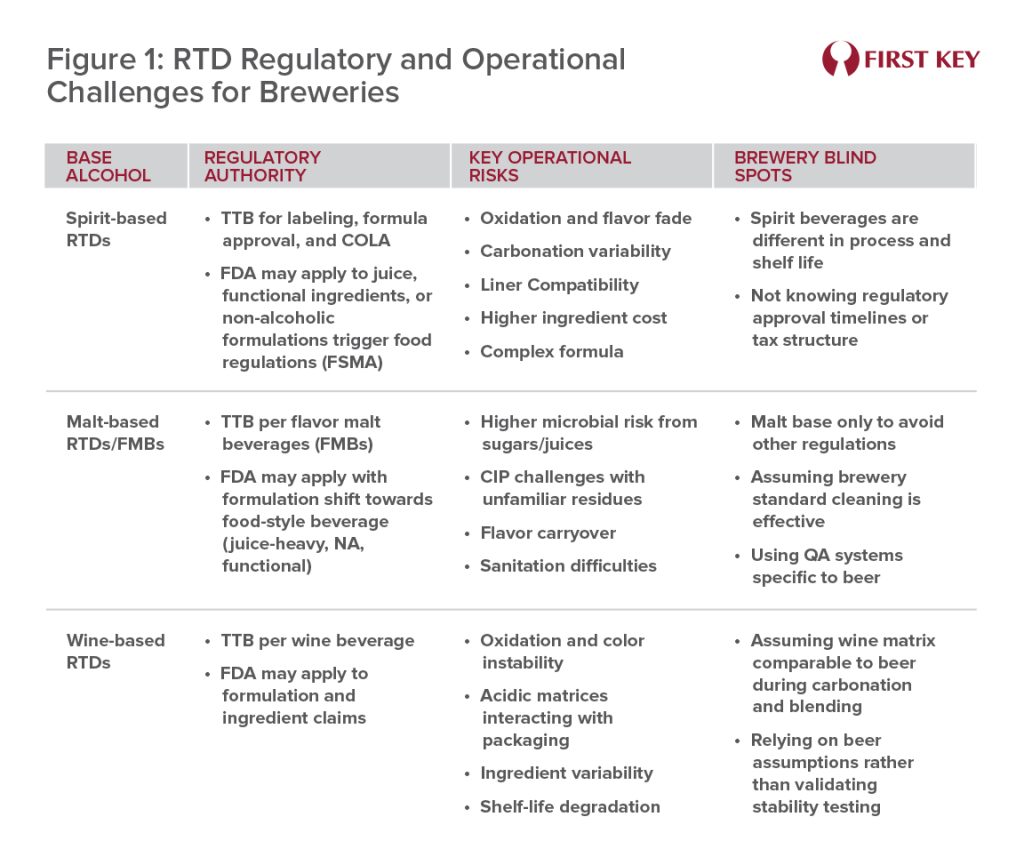
Regulatory Reality: Where Breweries Get Burned
RTD cocktails frequently expose breweries to regulatory risk because oversight depends on what’s in the can rather than who makes it. The formulation determines whether a product falls under the jurisdiction of the TTB or the FDA. This distinction carries major implications for compliance, testing, and documentation. Like beer, alcohol-based RTDs typically require formula approval, compliant labeling, and a Certificate of Label Approval (COLA). These familiar processes can be underestimated in both timeline and complexity with a new product, and recognizing these regulatory distinctions is critical for operational planning and risk management.
Products that fall under FDA jurisdiction trigger a different set of obligations. Considerations are under the Food Safety Modernization Act (FSMA), preventive controls and food safety plans, which breweries may not be familiar with prior to considering RTD cocktail production.4
Distribution further complicates matters with RTD cocktails. Taxed and regulated differently from state to state, these variabilities affect margins and route-to-market strategy.5 To avoid these hurdles, some producers turn to malt-based workarounds, which are effective in the short term, but are cautioned by legal scholarship because these structures can limit future flexibility, brand positioning, and acquisition value.6
Food Safety & Microbial Risk in RTDs
RTD cocktails have a fundamentally different food safety profile from beer. Shaye Holdaway, Quality Manager at Prost Brewing Company, describes “New ingredients always carry a little risk because of unfamiliarity with their analytics and microbial potential. In addition, new ingredients can sometimes carry unwanted microbes that may not be beer spoilers but can become environmental contaminants that are much harder to get rid of. Understanding these ingredients and paying close attention to their Certificates of Analysis (COAs) is extremely important!”
These ingredient-level uncertainties are part of what makes functional or mixed beverages more challenging to manage from a QA standpoint. Flavors, combined with added sugars, create a microbial landscape more similar to that of juice or soft drinks than to beer. These differences increase susceptibility to spoilage organisms and pathogens. When juices, purees, or botanical extracts are added, microbial risk compounds increase due to greater nutrient availability and variable ingredient quality.
For RTDs containing juice, federal guidance requires these products to be manufactured under a Hazard Analysis and Critical Control Point (HACCP)-style framework, emphasizing hazard identification, preventive controls, and validated kill steps.7 Products regulated under the FDA may also fall under FSMA’s Preventive Controls rule, requiring documented food safety plans and verification activities.8
Microbial control strategies such as pasteurization, preservatives, and pH management must be validated for each batch of the specific formulation, given inevitable small variations in production. Refrigeration alone is rarely sufficient because the cold chain reduces growth, but it will not replace validated microbial controls. In addition, there is little to no protection against temperature abuse during distribution, retail, and with the end consumer.
Chemical Stability & Shelf-Life Challenges
Chemical stability, not just microbial safety, can often define whether RTD cocktails succeed or fail in the market. Oxidation, a familiar problem in beer, is a primary driver of flavor fade in RTDs. Aromatics are dulled, volatile compounds are lost, and yet the beverage may still appear visually satisfactory. Oxygen ingress during blending, carbonation, or packaging can significantly shorten sensory shelf life, even when microbiological risk appears controlled.9
Sweetener systems introduce additional complexity. Reducing sugars can participate in browning reactions and degradation pathways that alter color, sweetness perception, and flavor balance over time. Of note, degradation increases in acidic or warm storage conditions.10 These reactions may not present as obvious defects early on, but they can drive a gradual decline in quality, eroding brand trust.
Carbonation adds another variable. Carbon dioxide (CO₂) loss and package pressure variability affect mouthfeel, aroma release, and package integrity, especially when RTDs move through uncontrolled distribution and retail environments. Microbial activity, even if at low levels, can further destabilize carbonation and flavor systems.11
The most common failure point is assuming that RTDs behave like beer from a stability perspective. Many RTDs launch with shelf-life timelines inferred from beer or spirits experience, not necessarily validated by stability testing, leaving producers exposed to premature quality failures in-market. Proper validation ensures product stability, protects brand reputation, and supports consumer satisfaction, making it a vital operational consideration for successful RTD deployment.
Equipment, Packaging, and Cross-Contamination
RTD cocktails often run through brewery infrastructure designed for beer, but this mismatch of beverages is a frequent source of quality failure. Holdaway notes, “Your equipment on the production side and quality side is not necessarily made for other types of products besides beer! “We have had issues with ABV through the alcolyzer, mixing of adjuncts in a tank, or packaging of still products without CO2. Just because it is another beverage going in a can does not mean it is going to perform the same way a typical beer would!”
In using beer-based processing equipment for RTDs, new residues (sugars, juices, etc.) are introduced that behave differently during cleaning. Traditional brewery clean-in-place (CIP) programs are optimized for beer production, which may be insufficient for carbohydrate- and alcohol-rich matrices found in RTDs, increasing the risk of biofilm persistence and flavor carryover.12
Packaging creates additional challenges since can liners and closures must be compatible with higher alcohol content, acidic juices, and botanical extracts. Certain liner chemistries may be more prone to interactions or migration when exposed to non-beer formulations, potentially affecting the RTD’s flavor stability and shelf life.13 These interactions are often subtle, becoming apparent after weeks or months in distribution.
An additional consideration is sanitation. Strong flavors and aromatics common in RTDs can persist in gaskets, valves, and filler components, leading to cross-contamination between brands or SKUs if segregation and validation are not enforced. Sanitation efficacy goes beyond the naked eye to create hygienic control, particularly in mixed-beverage facilities.14 For RTDs, equipment suitability and verified cleaning are part of a proactive quality plan rather than a reactive afterthought.
Minimum Quality Controls Before Scaling
Before RTD cocktails move from pilot batches to full-scale production, quality controls must be established to prevent expensive failures. Ingredient vetting is the first gate for juices, sugars, botanicals, and compounded flavors. Asking for supplier qualification, Certificates of Analysis, and clear specifications is critical and often exceeds what breweries require for malt and hops.
From there, producers need a defined process design and validated control steps. Under the FDA’s Preventive Controls framework, manufacturers are expected to identify hazards, implement preventive controls, and verify their effectiveness through monitoring and corrective actions.15,16 This operational monitoring, through analytical testing, must also extend beyond standard beer quality. pH, dissolved oxygen, sugar concentration, preservative levels, and shelf-life stability testing are critical for RTDs, particularly those with juice or low alcohol content.
Finally, documentation and traceability are not optional at scale. Food safety plans, batch records, and ingredient traceability protect producers during audits, recalls, and distributor inquiries. International frameworks such as ISO 22000 emphasize that documented systems are foundational to controlling risk in mixed-beverage operations.17
Financial & Strategic Considerations
RTD cocktails often appear attractive on a per-unit margin basis, but hidden costs can quickly erode projected profitability as highlighted in the First Key article on Brewery Profitability Analysis and Improvement. Compliance expenses from: formula approvals, labeling revisions, state registrations, and food safety documentation, etc. add ongoing overhead that is rarely captured in early forecasts. There is often rework, especially during finalization and optimization of the production process, stemming from stability failures or out-of-spec batches, which can further compress margins. In addition, recalls or market withdrawals can introduce sudden, high-impact costs tied to logistics, destruction, and reputational damage.18 Financial modeling for RTDs must therefore account for quality control, spoilage risk, and shelf-life loss beyond ingredient and packaging costs. Distribution complexity compounds this risk. RTDs face different tax and shipping rules across states, which influence landed costs and channel strategy in ways beer producers may underestimate.19
Brand risk is a critical variable beyond marketing. RTD failures often occur in the consumer’s hand, such as flat carbonation, flavor fade, haze, or off-odors, and recovery is difficult. Distributor relationships amplify this exposure because large wholesalers scrutinize portfolio performance and risk tolerance before making commitments.20
For many breweries, contract production can be a strategic alternative. Co-manufacturers with validated processes and regulatory infrastructure may reduce capital exposure and speed time-to-market, particularly during early category exploration.
Managing the Overall Risk to Successful Production
RTD cocktails can be a viable growth path if breweries treat them as new manufacturing programs rather than incremental extensions of beer. The most successful producers acknowledge that RTDs introduce different hazard profiles, stability challenges, and regulatory expectations, and they build systems accordingly. Under the FDA’s Preventive Controls framework, risk relief comes from identifying hazards, validating controls, and documenting performance before products scale into broad distribution.21
From a technical standpoint, even seemingly familiar elements like carbonation behave differently in RTDs, affecting flavor release, package pressure, and shelf-life performance.22 All of these variables must be measured and controlled rather than guessed or assumed from other beverages.
Risk-aware planning ultimately protects what matters most: capital, brand equity, and distributor and consumer trust. By investing early on in quality systems, validation, and realistic margin modeling, breweries are better positioned to absorb operational complexity without compromising their core business. In a category defined by rapid growth and equally rapid failure, disciplined execution is the most reliable way to mitigate risk and build a successful RTD beverage program.
In the end, beer producers can successfully navigate the risks related to RTD production. It may seem daunting at first, but there are many resources available to help producers. Find yourself a good technical partner whom you trust and can rely upon to show you the way and help you manage the “risk: and avoid the pitfalls of producing an RTD for the first time.
To learn more about technical and business planning services for RTD beverages, contact us
By Frances Tietje-Wang
1 https://www.theiwsr.com/insight/spirit-based-rtds-continue-to-be-a-bright-spot-for-the-us-market/
2 https://www.ttb.gov/regulated-commodities/labeling
3 https://www.theiwsr.com/insight/how-are-rtds-reshaping-sesonality-in-the-us/
5 https://www.ncsl.org/financial-services/direct-shipment-of-alcohol-state-statutes
6 https://scholarlycommons.pacific.edu/cgi/viewcontent.cgi?article=1351&context=uoplawreview
7https://www.fda.gov/regulatory-information/search-fda-guidance-documents/guidance-industry-juice-hazard-analysis-critical-control-point-hazards-and-controls-guidance-first; https://www.ecfr.gov/current/title-21/chapter-I/subchapter-B/part-120
8 https://www.fda.gov/food/food-safety-modernization-act-fsma/fsma-final-rule-preventive-controls-human-food; https://www.ecfr.gov/current/title-21/chapter-I/subchapter-B/part-117
9 https://pmc.ncbi.nlm.nih.gov/articles/PMC9000708/
10 https://pmc.ncbi.nlm.nih.gov/articles/PMC12154226/
11 https://www.frontiersin.org/journals/microbiology/articles/10.3389/fmicb.2022.979866/full
12 https://doi.org/10.1533/9780857098634.3.305
13 https://www.mdpi.com/2306-5710/6/2/37
14 https://pmc.ncbi.nlm.nih.gov/articles/PMC11355484/
17 https://www.iso.org/iso-22000-food-safety-management.html
18 https://www.fda.gov/safety/recalls-market-withdrawals-safety-alerts
19 https://www.ncsl.org/financial-services/direct-shipment-of-alcohol-state-statutes
20 https://www.sfchronicle.com/food/wine/article/rndc-republic-national-distributing-co-21304938.php