Hemp-derived THC beverages have moved from curiosity to a legitimate commercial category. The consumer demand is no longer theoretical and the route-to-market model is evolving.
In 2025, Diana Eberlein, chair of the Coalition for Adult Beverage Alternatives (CABA), estimated the hemp beverage market at nearly $1 billion, with the potential to reach $5 billion within a few years. The category just captured $239 million in mainstream retail business, growing 135% year or year, before accounting for dispensary sales, direct-to-consumer, and other non-measured channels [1]. In a current environment where beer, wine, and spirits sales are taking a hit, that growth is noteworthy. NielsenIQ (“NIQ”) also reports that 50% of U.S. adults are interested in trying cannabis-infused beverages, with growth concentrating in familiar retail channels such as liquor, food, and convenience [2].
The NIQ numbers capture mainstream measured retail, and that matters because the category is not just scaling. It is scaling through fragmented infrastructure. This is not just limited to off-premise – according to the 2026 Crescent Canna consumer survey, 83.2% of respondents said they would be more likely to consume THC beverages if they were more widely available in bars, restaurants, and venues.
Kaliegh Theriault, Director of BevAlc Thought Leadership at NielsenIQ, described THC beverages as “a new adjacency to BevAl” and said winning players will recognize the category as incremental, with a distinct role and clear source of consumer demand. That is the strategic opening. But, the commercial question is more complicated: which companies can turn demand into repeatable, compliant, account-level sales?
That question has become more urgent because the category is heading toward a major regulatory reset. Beginning in November 2026, the HempTHC loophole from the 2018 Farm Bill will again hit the legislative floor. The current proposal would limit hemp-derived products intended for human or animal consumption to no more than 0.4 milligrams of total THC per container [3]. If that threshold takes effect as written, many current hemp-derived THC beverage formats would need to reformulate, shift channels more into cannabis-licensed systems, or pause distribution in any affected markets.
In the meantime, for beverage companies, breweries, distributors, and retailers, THC beverages are not simply a product innovation story, they are a route-to-market stress test.
THC beverages sit between several consumer trends: alcohol moderation, cannabis normalization, low-dose adult occasions, functional beverage and a demand for alternatives to beer, wine, and spirits. The format itself is familiar. It is social, cold, portioned, merchandisable, and easy to understand compared with many traditional cannabis formats.
That is why beverage companies are interested. That’s why mainstream retail is interested.
Many traditional retailers are seeing a broader benefit to the inclusion of these products on shelf. Dan Razowsky, director of marketing, category manager and pricebook coordinator for Northbrook, Illinois-based Rmarts convenience stores, said when THC products are included growth accelerates. As a frame of reference, Razowsky said beer alone delivered steady year-over-year gains from July 1, 2025, through Feb. 28, 2026, with unit sales up 5%, gross profit dollars rising 15% and margins improving by 2 percentage points. When THC products are included, total units increased 11%, gross profit jumped 31% and margins expanded by 4 points.
According to Razowsky, THC is generating incremental business rather than eroding beers sales.
Throughout 2025 and early 2026, Spec’s, Total Wine & More, Sprouts, Target, and many convenience chains all added Hemp-derived THC beverages to their sets. In Crescent Canna’s 2026 consumer survey, 69.8% of respondents consume THC beverages at least once per week, including 37.7% who consume these products three or more times weekly.
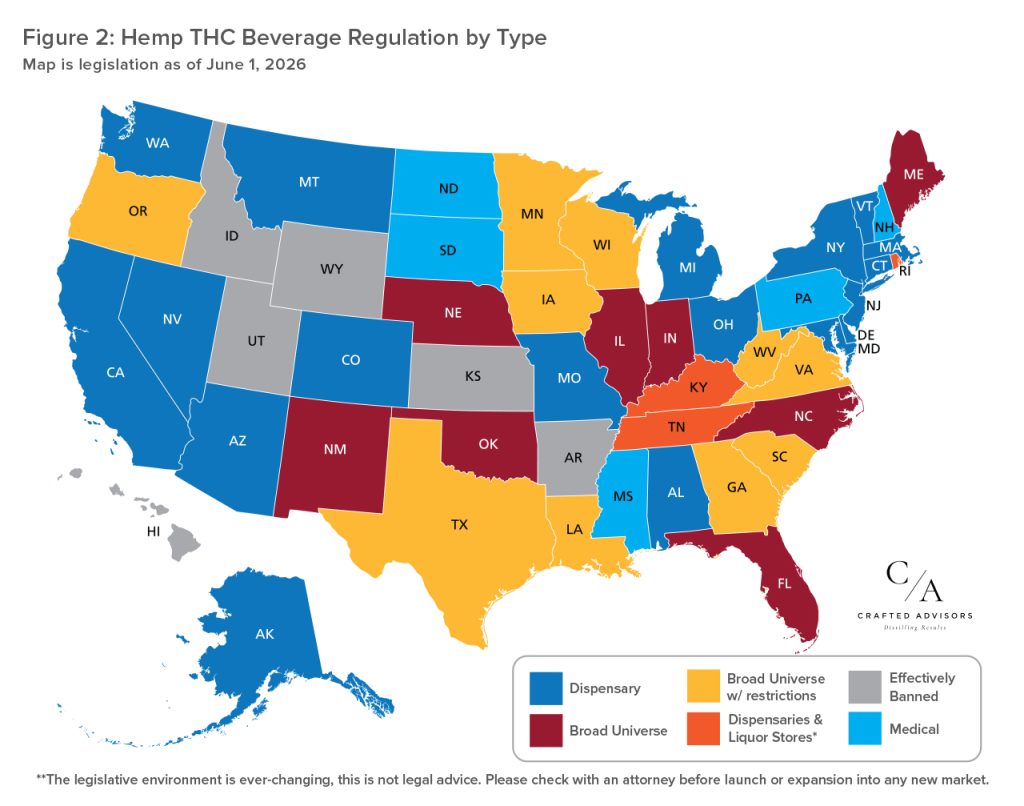
But the path to purchase is not uniform. A 5mg hemp-derived THC beverage might sell through liquor channels in one state, convenience stores in another, cannabis dispensaries in a third, and direct-to-consumer where legally allowed. In some states, beer wholesalers may be the best route to shelf. In others, wine and spirits wholesaler may control the right account universe. In stricter markets, the cannabis shop route may be the only viable path.
The first decision is not simply, “which distributor will take the brand?” The first decision is which route-to-market model matches the market, product, channel, and regulatory reality.
The Three Primary Routes To Shelf
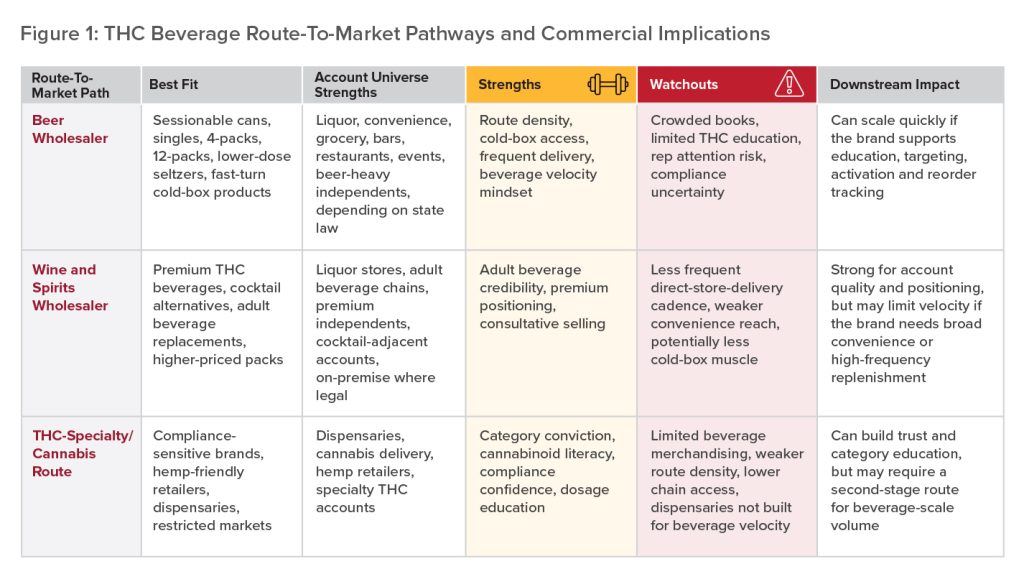
There are several ways Hemp-derived THC beverages can reach consumers, but most fall into three primary commercial pathways: beer wholesaler, wine and spirits wholesaler, and THC-specialty or cannabis-licensed distribution. Direct-to-consumer can support all three where legal, but it generally operates as a companion channel rather than a replacement for physical retail execution.
Beer Wholesaler Route
The beer wholesaler route is often the most natural fit for session-able canned THC beverages, especially in markets where the category can legally move through alcohol-adjacent retail.
Beer wholesalers bring route density, cold-box experience, frequent delivery, independent account coverage and experience selling high-velocity beverage formats. Their outlet universe is broad, the format is familiar, and their speed to market is impressive.
That matters because many THC beverages behave more like beer alternatives, flavored malt beverages, ready-to-drink cocktails or non-alcohol beverages than traditional cannabis products. Singles, 4-pack, 12-packs, lower-dose seltzers and fast-turn cold-box items often fit the beer model.
The advantage is speed and coverage.
The risk is attention. Beer wholesalers already carry crowded books, and THC beverages compete for sales focus against a slew of other products. If the brand does not bring education, retail targeting, compliant sell sheets, funding, dosage training and activation support, it may get placed but not pulled through. They are masters at creating scale, but only if the brand is ready to support field execution. Without velocity, the product becomes one more slow-moving SKU in a crowded warehouse.
Wine & Spirits Wholesaler Route
The wine and spirits wholesaler route can be effective in markets where THC beverages are sold primarily through liquor stores, adult beverage chains, premium independents, bars/restaurants, mass/grocery (where legal) and cocktail adjacent retail environments.
This route may be especially relevant for products positioned as alcohol alternatives, cocktail substitutes, premium social beverages or high-priced adult-use products. Wine and spirits wholesalers often have strong relationships with account operators and are familiar with education, staff training, and regulatory complexity.
The tradeoff is execution muscle. Wine and spirits wholesalers may not have the same high-frequency direct-store-delivery (DSD) cadence as beer wholesalers. They may not call on the same convenience universe, and they may also be less built around cold-box velocity, singles, high-turn replenishment or rapid display cycling.
For premium THC beverages, cocktail-style formats, or higher-end products that need a more consultative adult beverage sell, the wine and spirits route can create credibility and account quality. For brands that need broad convenience, rapid cold availability or high frequency replenishment, it may limit the velocity ceiling unless paired with the right account strategy.
THC-Specialty Route
The THC-specialty and cannabis-licensed route includes dispensaries, licensed cannabis distributors, cannabis delivery platforms and state-regulated cannabis retail systems. THC-specialty distributors while not always operating inside the same licensed cannabis framework, may also serve as category-focused operators in hemp-derived THC markets.
These routes offer one important advantage: category conviction.
Cannabis operators and THC-focused distributors often understand cannabinoids, dosage, certificates of analysis, retailer questions, testing and compliance friction better than traditional beverage wholesalers. They may be willing to educate accounts and build the category from the ground up. In markets where hemp-derived THC beverages are restricted or pushed into cannabis systems, this may be the only viable route.
But there are beverage limitations. Dispensaries are not always built for beverage velocity. Cold storage can be limited. Beverage merchandising is often secondary, and the consumer may be shopping for flower, vapes, gummies or higher concentrates rather than a social drinking occasion. Foot traffic is another challenge, not all consumers are comfortable in a dispensary, limiting the consumer base.
THC-specialty distributors face a different challenge. They may bring sharper focus and stronger category education, but they may lack route density, working capital, chain relationships or the scale needed to support the broader market. This route can build credibility and compliance confidence, but it may not deliver beverage-scale velocity without additional retail access or a second-stage distribution strategy.
Direct-to-Consumer as a Supporting Route
Direct-to-consumer should not be ignored. Where legal, it can support education, first-party data, consumer feedback, trial, subscriptions, and market validation. For an emerging category, those are valuable tools.
But, direct-to-consumer should be viewed as a supporting route-to-market layer, not the entire commercial plan. Direct-to-consumer can help prove demand, but it does not replace account-level retail execution. For most beverage brands, DTC works best in tandem with physical distribution.
Market Selection Before Distributor Selection
The strongest THC beverage companies will not simply chase the broadest footprint. They will sequence markets based on where the route-to-market can work.
A fragile 20-market footprint is not more valuable than three markets with clear regulation, engaged distributors, trained retailers, repeat purchase and measurable reorder behavior.
Market sequencing should consider regulatory clarity, permitted channels, likely impact of the November 2026 reset, beer versus wine and spirits versus cannabis distribution fit, retailer willingness, distributor capability, field support requirements, consumer awareness, competitive intensity, age-gating expectations, data visibility, velocity measurement and fallback options if rules change. It is a long checklist.
The best first markets may not be the largest. They may be the markets where a brand can prove that the product sells, reorders and survives real retail conditions.
Distributor Fit Is A Capability Question
For THC beverages, distributor choice should not be treated as a check-the-box exercise. A well-known wholesaler may provide reach but reach alone does not guarantee that the right accounts will be called on, the product will be explained correctly, or the sales team will prioritize the brand after the first shipment.
The better question is whether the distributor’s infrastructure matches the job the channel needs to deliver. The growth story shows that demand exists, and the right route-to-market can convert interest into repeatable and scalable sales for the market. A beer wholesaler may be well suited for cold-box velocity, convenience reach, and call frequency; while a wine and spirit wholesaler may be better positioned for liquor-store credibility, premium adult beverage accounts and staff education. Demand is only one part of the equation.
Brands should pressure-test several questions before assigning a market: Does the distributor understand the legal category? Does it call on the right account universe? Can its sales team explain dosage, occasion and compliance guardrails? Will it actively sell the product or simply list it? Does it have cold-box access where needed? Can it support chain or independent retail authorization? Will it share depletion and reorder data? Does the product fit its portfolio incentives? Will the brand get attention after the first shipment?
One of the biggest mistakes a brand can make is treating distribution as a binary decision – it determines overall market access. A distributor appointment is not just a logistics choice – it determines the account universe and future success.
The first purchase order is not the real test. The second, third and fourth reorder from the same account are better indicators of whether the route-to-market is working.
Each route-to-market opens access to different retailer universes. For example, a 5mg THC seltzer in a liquor store behaves like an adult beverage alternative. The same product in a dispensary behaves like cannabis. Each channel has different consumer profiles and occasions, and the route-to-market is not just how the product gets to shelf. It shapes how the consumer understands the product.
November 2026 Is The Planning Date
The November 2026 federal reset should be treated as a commercial planning date, not simply a legal deadline.
If the federal restriction takes effect as written, many current hemp-derived THC beverages may need to reformulate, exit certain channels, shift into cannabis-licensed systems or pause sales in affected markets. The National Association Of Convenience Stores (NACS) has stated that the current 0.4 milligram THC limit would effectively ban the industry as it exists today [3].
“I’ve heard loud and clear from brewers, farmers, and small businesses in Minnesota – a federal ban on hemp products will be devastating.” – Amy Klobuchar (D-MN)
If Congress creates a more workable regulatory path, the category may move toward age gates, testing standards, labeling requirements, dosage limits, licensing and channel controls rather than broad prohibition.
If state-level divergence continues, brands may need flexible route-to-market models by state. Some markets may support alcohol-adjacent sales while others may move products into cannabis channels. Others may restrict convenience, grocery or broad retail access.
For beverage companies, the implication is clear: one national playbook may not be enough.
What Companies Should Build Now
THC beverages may have significant upside, but the beverage category is not forgiving. Each brand must prove within the first 90-120 days viability – reorder and velocity – without it, a brand will lose its place on shelf. Companies evaluating entry or expansion should build the commercial roadmap before chasing footprint.
That includes a state-by-state route-to-market map, distributor scorecard by market type, channel and account universe strategy, retailer education tools, compliant claims and selling materials, testing and certificate-of-analysis protocols, field activation plan, reorder and velocity targets by account type, direct-to-consumer support strategy where legal, November 2026 scenario plan, fallback formulations or brand architecture, market exit plan if regulation changes and a capital plan that does not assume uninterrupted national expansion.
The next phase of THC beverages will separate companies that have distribution from companies that had infrastructure.
The product matters, but product alone will not carry the category. The durable advantage will come from route-to-market discipline: choosing the right markets, matching the right distribution model to the account universe, supporting retailer education, tracking reorder behavior and preparing for regulatory change before it arrives.
For breweries, beverage companies and THC beverage brands, the work now is not simply launching a product. It is building a path and solution to different regulatory outcomes and a route-to-market system that can flex with the rules, and we at First Key are here to help. Whether you’re evaluating the opportunity or preparing for commercial launch, First Key can help create a practical roadmap for safe, efficient, and scalable production. Contact us to learn more today.
Note to readers: This article is not legal advice. Cannabis and hemp-derived THC regulation remains an evolving landscape. Companies should consult an attorney specializing in the relevant state before shipping, selling or buying at scale.
Sources:
[1] NielsenIQ Retail Tracking 52-week period ending April 4, 2026.
[2] NIQ Perspective: Buzz Worthy Report, April 2026
[3] Libation Law Blog: “New Federal Hemp Rules and the 0.4 mg THC Cap: Bad News for Hemp Drinks” by Ashley Brandt – Nov 13, 2025[4] Crescent Canna: 2026 THC Beverage Consumer Survey