
As breweries expand into total beverage operations, the question of a brewery’s capacity is becoming more dynamic. Is the brewery capable of taking advantage of these new opportunities with shifting product demands, operating realities, and evolving constraints?
“We can totally fit that somewhere…”
It’s a phrase that has echoed through breweries for years, whether it meant finding space for one more fermentation vessel, adding a bright tank in a tight corner, or squeezing in a piece of used equipment that felt too good to pass up. Historically, those decisions were made within systems that were, if not simple, at least predictable. Traditionally, brewing followed a relatively linear flow. Capacity could be estimated with reasonable confidence, and while constraints existed, they tended to be well understood.
Today, that environment is changing rapidly and fundamentally.
Across the industry, many breweries are no longer operating as single-product producers. They are evolving into total beverage manufacturers, producing a mix of beer, RTDs, non-alcoholic beverages, flavored malt beverages, and co-manufacturing products. With that shift comes a level of operational complexity that traditional approaches to capacity planning were never designed to handle.
At its core, capacity planning defines the maximum sustainable output of the equipment or processes providing a foundation for both short-term operational decisions and long-term capital strategy. There is a critical distinction that becomes increasingly important in today’s environment: the difference between design capacity and effective capacity. While design capacity reflects what equipment is theoretically capable of producing, effective capacity is constrained by real-world conditions: downtime, changeovers, labor availability, variability, and system inefficiencies.
In a traditional brewing operation, those constraints were relatively stable. In a total beverage environment, they are not.
As one industry perspective summarized it:
“Most of our clients are no longer thinking of themselves as just breweries. Capacity modeling is what allows them to understand what they can actually produce across an increasingly complex portfolio,” says Mike Gerhart, Senior Advisor Technical Services from First Key Consulting.
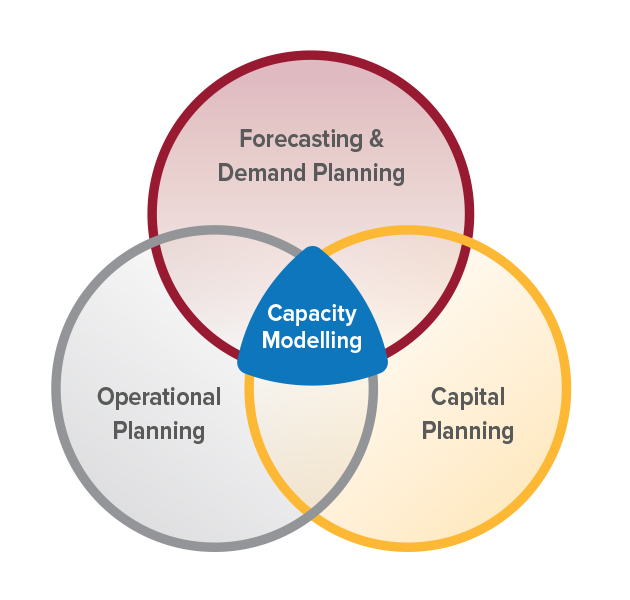
That shift, from estimating capacity to actively modeling it, is becoming one of the defining capabilities separating reactive operators from those who are strategically positioned for growth. Think of capacity modelling as the intersection of forecasting and demand planning, operational planning and capital planning. A clear understanding of how these plans collaborate is essential to achieving success in the Total Beverage era.
Why Total Beverage Breaks Traditional Capacity Thinking
In its simplest form, brewing has historically operated as a sequence. Wort is produced in the brewhouse, fermented in tanks, transferred to bright beer tanks (BBT), and packaged for distribution. Each stage has its limitations, and some recipes have unique aspects, but the flow was generally consistent. Capacity planning in this context often revolves around familiar constraints: tank volumes, brewhouse throughput, packaging line speed, etc.
The introduction of a total beverage portfolio disrupts this sequence:
- Different products follow different paths through the system.
- Some share equipment, others have unique equipment.
- Some require fermentation; others do not.
- Some have long tank residency times; others may bypass the tank entirely.
- Batch sizes vary, processing steps diverge, and timelines become less predictable.
What was once a uniform flow becomes a network of overlapping demands competing for shared resources.
To compound the complexity, packaging has become dramatically more complicated due to customer requirements and market demands. SKU proliferation has increased the number of products moving through the system, while also reducing the size of individual runs. A line that once ran long, uninterrupted SKUs may now be switching formats, sizes, brands multiple times per shift. Each changeover introduces lost time, labor inefficiency, and variability in throughput.
These dynamics compound across the operation. Available production time shrinks, not because equipment is faulty, but because it is constantly transitioning between tasks. This complexity also pressures the ability to be focused and consistent leading to training gaps and maintenance challenges. Even utilities, which were often secondary constraints in traditional brewing, can become primary limitations as demands increase. CO₂ supply, glycol capacity, compressed air, and electrical infrastructure all begin to shape what is actually possible.
Perhaps most significantly, the gap between rated capacity and operating capacity continues to widen. Equipment may still perform as designed, but the system around it no longer allows it to operate at that level consistently.
The result is a fundamental shift in how capacity must be understood. It is no longer a fixed number tied to equipment specifications. It is a dynamic outcome of how the entire system operates under real-world conditions.
From Assumption to Insight
In an environment defined by variability, relying on intuition alone becomes increasingly risky. Decisions that once felt straightforward, such as adding tanks, increasing line speed, and expanding production, can now produce unintended consequences if they are not evaluated in the context of the full system.
Capacity modeling provides a way to move beyond those assumptions. Capacity is typically approached through three primary strategies: lag, lead, and match.
- A lag strategy adds capacity only after demand has exceeded current capabilities, minimizing risk but constraining growth.
- A lead strategy adds capacity ahead of demand, enabling growth but increases capital investment risk.
- A match strategy incrementally aligns capacity with anticipated demand over time.
At First Key, our capacity modeling approach is fundamentally rooted in the match strategy, using data-driven insights to sequence operational changes and capital investments in step with real system constraints and demand evolution.
Rather than relying on generalized estimates, modeling builds a structured and visual representation of how an operation actually functions. It forces assumptions to be made explicit: how many hours are truly available for production, how long changeovers for each sku actually take, how different products occupy equipment, and how utilities support or constrain operations.
The goal of this modeling is not simply to calculate output. It is to identify what is limiting output based on volume mix scenarios leading to defined solutions to achieve forecasted volumes. This distinction is critical.
In many cases, the perceived constraint and the actual constraint are not the same. A brewery that believes it is constrained by fermentation capacity may find that packaging inefficiencies are the true bottleneck. Another operation may discover that utilities, not process equipment, are the first limitation encountered as volume increases.
This leads to a fundamental reframing of the capacity question. Instead of asking what equipment needs to be added, organizations begin to ask what the system itself is preventing them from doing.
Answering that question with clarity changes how decisions are made. It shifts investment away from general expansion and toward targeted intervention. It enables leadership to understand not only what is limiting them today, but what will limit them next.
Case Study: Portfolio Expansion without Modeling
Consider a scenario that has become increasingly common.
A brewery is expanding into RTD production to broaden its portfolio and capture new demand. Anticipating higher throughput requirements, the team identifies BBT capacity as the likely constraint and invests in additional tanks. The decision is logical based on traditional planning assumptions.
However, the system behaves differently than expected.
With the introduction of new SKUs and formats, packaging operations become more complex. Changeovers increase in frequency, reducing overall line efficiency. What was previously a stable, high-throughput packaging process becomes fragmented and less predictable.
Despite the addition of BBT capacity, overall production does not increase as anticipated. Instead, the system begins to struggle downstream. Packaging becomes the limiting factor, forcing increased labor through overtime and shifts while upstream assets remain underutilized.
The outcome is not catastrophic, but it is inefficient. Capital has been deployed, but it has not addressed the true constraint of the new product mix. The facility now carries additional variable costs without fully realizing the expected gains by increasing COGS.
This type of situation illustrates a broader truth: without a clear understanding of system constraints, even well-intentioned investments can miss their mark.
Capacity as a Driver of Value Creation
When capacity modeling is approached as more than a planning exercise, it becomes a powerful driver of value creation across the business.
Typically, the most impactful insights from capacity modelling result in the ability to make change quickly to better overall capacity through non-capital decisions. This not only provides the ability to be more nimble but allows for potential capital investments to be well planned and targeted on the real constraints. As example, by understanding how production time is actually used within the system, organizations can identify opportunities to increase throughput through better scheduling, improved changeover efficiency, and more effective utilization of existing assets. These changes often require minimal capital but deliver immediate impact.
Beyond operations, capacity modeling can reveal process-level improvement opportunities. Adjustments to batch sizing, tank residency times, sequencing, or product mix can align production more effectively with system capabilities. These shifts may not require new equipment, but they can significantly improve output and efficiency.
When capital investment is required, modeling ensures that it is directed where it will have the greatest impact. Rather than expanding broadly, organizations can focus on the specific constraint that is limiting performance. This targeted approach improves the effectiveness of investment and reduces the likelihood of underutilized assets. The financial implications are substantial. Increased throughput drives revenue, while improved efficiency reduces the cost of goods sold (COGS). Margins improve, and capital is deployed more effectively, leading to higher returns on investment. Perhaps most importantly, modeling supports the ability to phase investments over time, aligning spending with actual demand rather than anticipated demand alone.
Brewing is an industry where capital intensity is high and margins can be very sensitive to operational performance; this makes the advantages of capacity modelling very meaningful.
A New Framework for Capacity Thinking
The shift to total beverage is not simply adding complexity; it is redefining how facilities think about their systems.
Capacity is no longer something that can be captured in a single number or evaluated once and revisited infrequently. It is a moving target, influenced by product mix, operating decisions, and infrastructure capabilities. Understanding it requires a more dynamic approach.
Organizations that succeed in this environment are those that develop a deeper awareness of how their systems behave. They recognize where constraints exist and how those constraints evolve. They use data, rather than assumptions, to guide decisions. They treat capacity modeling not as a one-time exercise, but as an ongoing capability.
For those who do not evolve their capacity approaches – the risks continue to grow. Investments become less effective, inefficiencies become harder to identify, and the gap between expected and realized performance widens.
For those who do shift their capacity methodology – the opportunity is significant. Better decisions, more efficient operations, and more resilient growth are all within reach. Once modeling becomes part of the operating mindset, a new realization often emerges quickly: The constraint does not stay in one place.
This article is part of the Capacity Modelling Insight Series by First Key. In the next article, we will explore what happens when bottlenecks shift through the system, and how understanding that movement changes the way operations and capital decisions are sequenced in the total beverage era.
Interested in understanding how capacity modelling can support your team? Schedule a Demo today