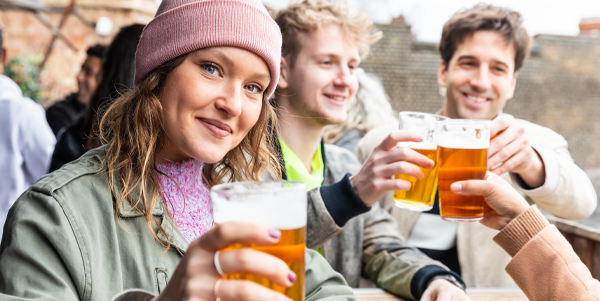
Non‑alcoholic (NA) beer has moved far beyond its reputation as a niche alternative. It has become one of the most dynamic growth engines in the global beverage landscape, reshaping consumer expectations and prompting both craft producers and multinational brewers to rethink their long‑term strategies. Traditional beer consumption in North America has been declining for more than two decades, while the non‑alcoholic segment is expanding at a pace unmatched elsewhere. Market forecasts show the global NA beer market rising from USD 20.5 billion in 2025 to USD 43.9 billion by 2035, growing at a 7.9% CAGR. Other analyses project the global market reaching USD 34.97 billion by 2032 at a 7.3% CAGR; with the US non-alcohol market forecast to grow at 18% CAGR, 2024 to 2028. This divergence between shrinking alcohol volumes and accelerating NA growth reflects a structural shift in the beverage alcohol landscape.
George Croft, Senior Advisor at First Key Consulting captures this moment succinctly: “A structural, moderation‑led shift in consumer drinking behaviour is driving double‑digit growth in non‑alcoholic beer while traditional beer continues to decline.”
Croft’s point is reinforced by broader cultural data. Gen Z and Millennials are drinking less alcohol than previous generations, with Gen Z consuming roughly one‑third less beer and wine than older cohorts and adopting alcohol‑free options at significantly higher rates. Surveys show that 65% of Gen Z and 55% of Millennials plan to drink less, and nearly 60% of Gen Z would order an NA beer if offered. This moderation movement is not fringe; it is becoming a normalized, cross‑generational behaviour driven by wellness, lifestyle alignment, and shifting social norms.
The rise of “sober curiosity” and the mainstreaming of Dry January have further accelerated this shift. More than half of U.S. drinkers now say they want to reduce alcohol consumption, and nearly a quarter participate in seasonal abstinence initiatives. As Croft notes, “Moderation isn’t cannibalization and about ninety percent of NA beer buyers also purchase alcohol. NA expands beer occasions and protects portfolio relevance.” In other words, NA beer is not replacing traditional beer so much as broadening the universe of drinking moments.
While large brewers still command the majority of NA volume, craft NA brands are rapidly gaining cultural relevance. Craft brands like Partake, Best Day and Athletic Brewing exemplify the authenticity and cultural relevance that resonate with today’s consumers. Their success is built on innovation, flavor diversity, and a commitment to product quality; that resonates with younger consumers who expect NA beer to deliver the same quality and diversity as full‑strength offerings.
Meanwhile, the broader beer industry is undergoing a category reshuffle. According to CNBC, non‑alcoholic beer is projected to overtake ale as the second‑largest beer category worldwide as early as this year, driven largely by younger consumers who are drinking less alcohol and seeking functional, wellness‑aligned beverages. This shift underscores the momentum behind NA beer and the urgency for brewers of all sizes to participate meaningfully in the category.
To thrive in the NA craft beer segment, brewers are conducting deeper portfolio assessments to understand where their offerings align, or fail to align, with evolving consumer expectations, investing in internal innovation pipelines to develop NA products that stand on their own merits rather than as alcohol‑free extensions of existing brands. Storytelling, influencer partnerships, and transparent communication are becoming essential tools for building credibility in a category where trust and authenticity matter.
Looking ahead to 2026 and beyond, the industry is likely to see a wave of strategic acquisitions and partnerships as larger brewers look to accelerate their relevance in the craft NA segment. The rationale is compelling. Acquiring a leading NA craft brand offers:
- Accelerated growth with immediate entry into a high‑growth category.
- Access to a full spectrum of drinking occasions that include “moderation moments” such as weeknights to sporting events. A global brewer recently stated “Not only does non-alcoholic beer help to premiumize our business, but it also creates value….by appealing to a wider range of consumer preferences and servicing more occasions”.
- Access to proprietary brewing techniques enabling R&D capabilities.
- A connection to younger consumers who increasingly define the future of beer.
- Operational synergies, diversified revenue streams, and the ability to scale distribution rapidly.
- Ability to shape the category and category leadership with established craft NA brands
Another global brewer stated that “20% of its beer volume will be non or low alcohol” underlining the importance of NA especially craft NA beer.
As Croft puts it, “The fastest path to relevance for a big brewer is pairing scale with an NA‑first craft leader—scale done right can amplify authenticity; authenticity unlocks occasions; occasions drive share.”
The NA beer revolution is not a passing trend. It represents a permanent reconfiguration of the beer landscape, driven by demographic change, cultural evolution, and product innovation. As Croft notes, “Nonalcoholic beer isn’t a niche, it’s the only structural growth engine in beer right now. Treat it as a platform, not a line extension.” Brewers that lead the NA beer revolution by investing in established craft NA brands stand to benefit immensely by attracting new consumers, participating in more consumption occasions and strengthening their brand portfolio.
References
- PR Newswire. Non‑Alcoholic Beer Market to Reach $34.97 Billion by 2032, Growing at a CAGR of 7.3% from 2025.
- CNBC. Non‑alcoholic beer projected to overtake ale as the second‑largest beer category worldwide.
- Future Market Insights. Rising Health Consciousness Fuels Non‑Alcoholic Beer Industry Growth.
- Future Market Insights. Non‑Alcoholic Beer Market Insights 2025–2035.
- Brewers Journal Canada. Global Non‑Alcoholic Beer Market Set for Robust Growth.
- IWSR. Key Statistics and Trends for the US No-Alcohol Market – IWSR.
- Molson Coors Q3 2025 Earnings Call.
- AB InBev.com. Smart Drinking Goals.